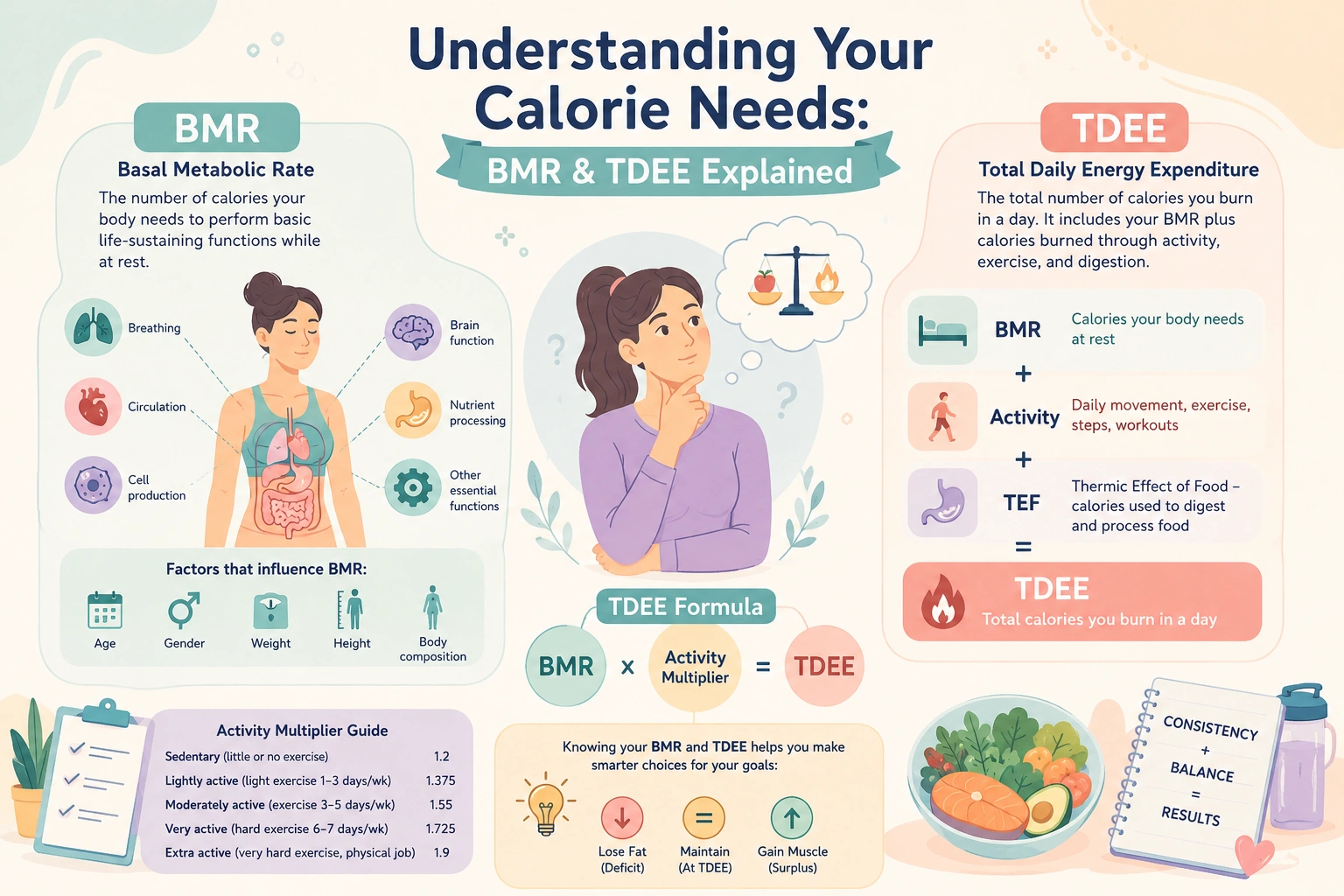
Before you can effectively manage weight, energy, or nutrition, you need to understand how many calories your body actually burns. This starts with two key concepts: BMR and TDEE.
What is BMR (Basal Metabolic Rate)?
Your BMR is the number of calories your body burns at rest. Even if you did nothing all day, your body still needs energy to function.
That includes:
- Breathing
- Circulating blood
- Cell repair
- Organ function
One of the most widely used formulas to estimate BMR is the Mifflin-St Jeor Equation:
For men:
BMR = (10 × weight in kg) + (6.25 × height in cm) − (5 × age in years) + 5
For women:
BMR = (10 × weight in kg) + (6.25 × height in cm) − (5 × age in years) − 161
What is TDEE (Total Daily Energy Expenditure)?
Your TDEE is your total daily calorie burn, including movement and exercise.
To estimate it, you multiply your BMR by an activity factor:
- Sedentary (little to no exercise): × 1.2
- Lightly active (1-3 days/week): × 1.375
- Moderately active (3-5 days/week): × 1.55
- Very active (6- days/week): × 1.725
- Extra active (physical job + training): × 1.9
Why This Matters
Knowing your TDEE helps you understand:
- How many calories you need to maintain your weight
- How to create a calorie deficit for fat loss
- How to eat enough if your goal is muscle gain or better energy
To make this more real, let’s use my own example.
I’m a woman, 29 years old, 54 kg, and 168 cm tall. To understand how many calories my body actually needs, we first calculate the Basal Metabolic Rate (BMR).
BMR = (10 × 54) + (6.25 × 168) − (5 × 29) − 161
Step by step:
- 10 × 54 = 540
- 6.25 × 168 = 1050
- 5 × 29 = 145
So the final result is:
540 + 1050 − 145 − 161 = 1284
This means my body burns around 1284 calories per day at complete rest – just to keep essential functions like breathing, circulation, and cell repair going, even if I did absolutely nothing all day.
But of course, no one actually stays at rest all day.
Since I’m very active, we multiply my BMR by an activity factor of 1.725 to estimate my Total Daily Energy Expenditure (TDEE):
1284 × 1.725 = ~2214 kcal/day
So in reality, my body needs around 2214 calories per day to maintain my current weight and support my lifestyle.
From here, everything becomes much more structured:
- Maintenance: 2214 kcal/day
- Fat loss: 1700-1900 kcal/day (moderate deficit, sustainable approach)
- Muscle gain: 2300-2500 kcal/day (small surplus to support growth and training)
Why this is important
This matters because your body is not the same as anyone else’s. Two people can eat the same “diet plan” and get completely different results simply because their energy needs are different. It also helps you avoid one of the most common mistakes: eating too little for too long. That often leads to low energy, constant hunger, and eventually burnout. On the other hand, knowing your maintenance and adjusting from there makes your progress more stable, sustainable, and easier to maintain long term.
Once you have that, everything else in nutrition becomes much easier to navigate.